
(Originally published on Feb. 9, 2026)
The evolution of logistics in
the Central American Pacific region is increasingly driven by the need for
integrated, agile solutions that are close to the markets. In this context, the coordination
between the operational capabilities of the Port of Chiapas and the logistics offering of
the ZDEEP (Puerta del Istmo Free Zone) emerges as a strategic alternative
that expands and strengthens the options for trade flows in
the region.
Added to this dynamic is a
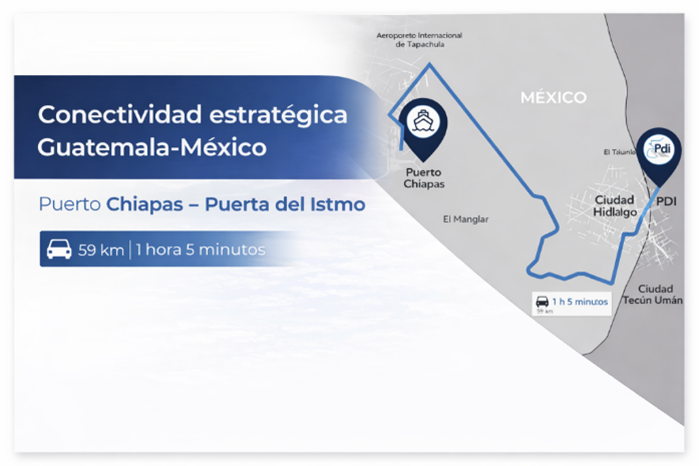
decisive advantage: the geographic proximity between the Port of Chiapas and the
Puerta del Istmo Free Trade Zone, located in Pajapita, San Marcos, Guatemala. The
distance between the two locations is approximately 59 kilometers, with a
travel time by land of about one hour, making this connection one
of the shortest and most efficient logistics corridors in the regional Pacific area.
This proximity translates into
lower operating costs, faster delivery times, and a
more predictable operation for importers, manufacturers, and logistics providers
seeking to remain competitive in an increasingly demanding environment.
The efficiency of the corridor is not
merely theoretical. Recently, the first ship from
Asia carrying goods destined for a customer in the ZDEEP Puerta
del Istmo Free Trade Zone arrived, using the Port of Chiapas as its port of entry.
The operation was carried out without
any anchorage time, which resulted in a significant reduction in
port costs and greater efficiency during unloading. Subsequently, the cargo was
transported under the international transit scheme, using Mexican
transportation, and entered the ZDEEP Puerta del Istmo directly.
This practical exercise validates the
integration of the port and the special economic zone and demonstrates how this connection is already generating
real and measurable benefits for operators and users of regional
trade.
A platform designed for
efficiency
The ZDEEP Puerta del Istmo operates
under a special regime in Guatemala that includes tax and
operational benefits, in line with the requirements of international trade. Added to this is
a key piece of infrastructure: its Transfer Center, which allows for the
direct entry of Mexican transport vehicles—vans, containers, and trailers with
Mexican license plates—without the need for transshipments or intermediate
maneuvers at traditional border crossings.
This model facilitates operations
within the weight and size limits authorized in Mexico, reduces the time required for
customs procedures, and integrates with the Guatemala–Mexico joint customs
schemes, eliminating historical barriers to land transit and
enhancing the efficiency of the regional logistics chain.
“At ZDEEP Puerta del
Istmo, we have worked to provide a logistics platform that reduces
barriers to cross-border trade. The Transfer Center is part
of that effort, and today, with the coordination of the international transit service
from Puerto Chiapas, it solidifies its role as an additional contribution by the ZDEEPs to
secure, efficient trade and logistics that meet the demands of
today’s global marketplace.”,
says Fredy Palma, CEO of Zona Libre Puerta del Istmo.
More Options for
Pacific Trade
 The combination of the
operational efficiency of the Port of Chiapas, the short overland distance, and the infrastructure
and conditions of the ZDEEP zone significantly expands the logistics options
for the Central American market.
The combination of the
operational efficiency of the Port of Chiapas, the short overland distance, and the infrastructure
and conditions of the ZDEEP zone significantly expands the logistics options
for the Central American market.
This corridor does not replace other
routes, but rather complements and strengthens the regional logistics network by providing a
more dynamic and competitive option that is aligned with the needs of
modern commerce.
In an environment where logistics
has become a key factor in competitiveness, this connection sends a
clear message: the Central American Pacific region is moving toward models that are more agile,
integrated, and better equipped to respond to the dynamics of global trade.