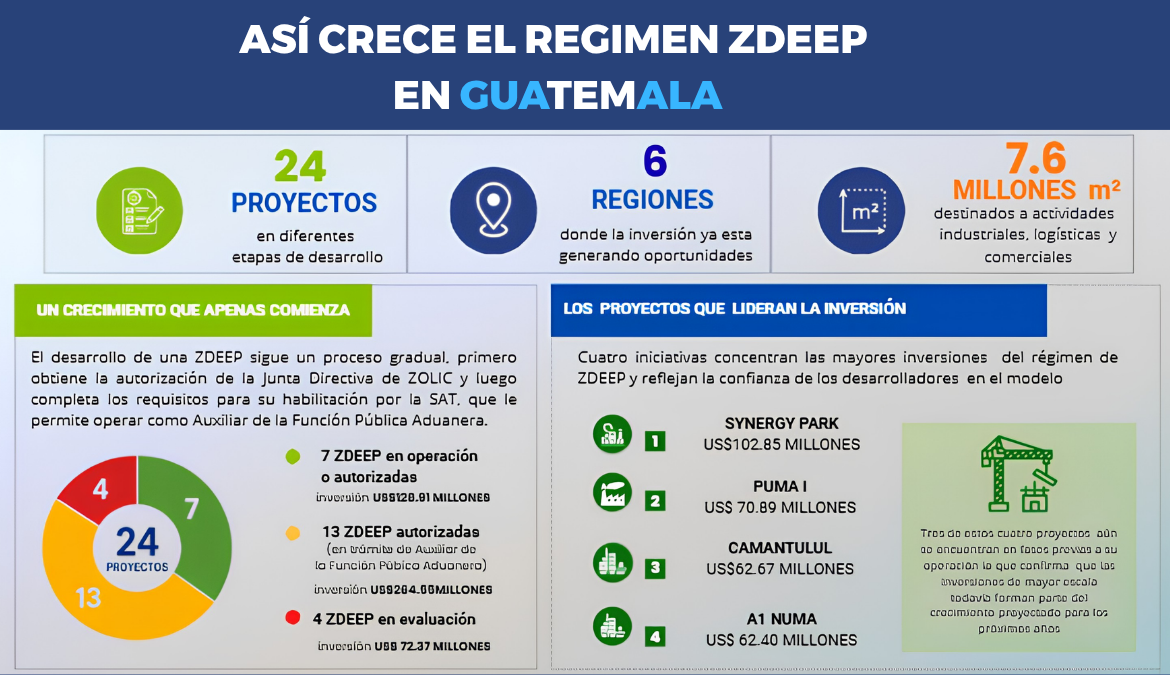
While much of the attention is focused on attracting new investment, a phenomenon is already taking place in Guatemala that is beginning to transform the country’s economic landscape. Under the model of Public Special Economic Development Zones (ZDEEP), administered by the “Santo Tomás de Castilla” Free Zone for Industry and Commerce (ZOLIC), there are currently 24 projects at various stages of development, with a cumulative investment exceeding US$$465.83 million and more than 7.6 million square meters dedicated to industrial, logistics, and commercial activities.
But the most revealing figure is not the total amount of investment. It is the fact that more than 72 % of that capital is still in the process of being incorporated into the system. While the ZDEEPs already in operation represent US$$128.91 million, the projects authorized by ZOLIC and those still under evaluation total US$$336.92 million—more than double the investment currently in operation. In other words, the model’s greatest growth is yet to come.
“When we see that investment in the pipeline far exceeds that already in operation, we see a sign of confidence in the ZDEEP model. This isn’t just about approved projects; we’re talking about investment decisions that reflect a long-term vision of Guatemala as a destination for developing industry, logistics, and trade,” notes Cristian Mayorga, chairman of the board of directors at ZOLIC.
A system that progresses in stages
The development of a ZDEEP follows a step-by-step process. First, it obtains authorization from ZOLIC; then, it fulfills the requirements for accreditation by the Superintendency of Tax Administration (SAT), which allows it to operate as an auxiliary to the Customs Service.
Currently, the system is divided into three phases:
- 7 ZDEEP projects approved or in operation, with a consolidated investment of US$$128.91 million.
- 13 projects authorized by ZOLIC, currently awaiting customs clearance, totaling US$$264.55 million.
- 4 projects under review, which would add an additional US$$72.37 million.
This composition reflects a model that has not yet reached maturity; on the contrary, it demonstrates an investment portfolio with significant growth potential.
The investment landscape is also changing
For several years, the ZDEEPs were primarily associated with the Pacific logistics corridor. However, their recent expansion paints a different picture.
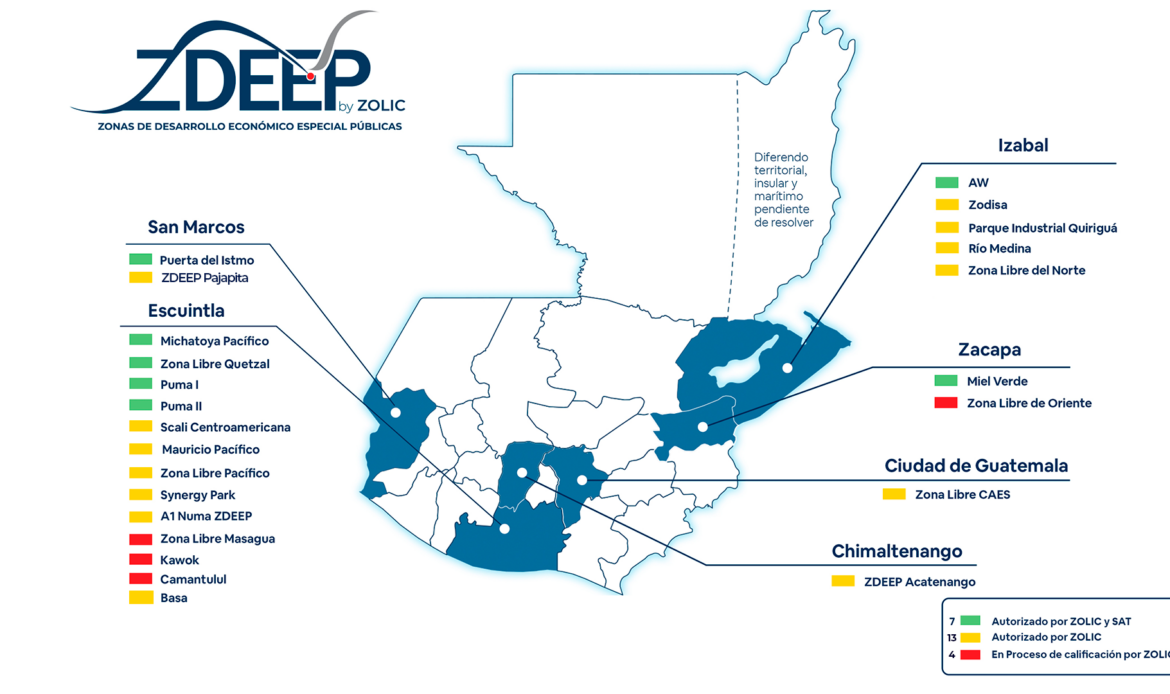
Escuintla remains the main hub of development, accounting for 13 of the 24 projects and the largest individual investments in the system. However, the presence of new ZDEEPs in Izabal, San Marcos, Zacapa, Chimaltenango, and the department of Guatemala confirms that the model is beginning to expand into other regions with distinct productive and logistical strengths.
Today, investment under this program already spans six regions of the country, strengthening Guatemala’s ability to diversify its industrial infrastructure and bring investment opportunities to new areas.
“One of the most significant changes we are seeing is the regionalization of productive investment. The ZDEEPs no longer represent a model concentrated in a single logistics corridor; today, they are generating opportunities in different regions of the country and strengthening a national network for investment and competitiveness,” says Cristian Mayorga, chairman of the ZOLIC Board of Directors.
The projects driving this expansion
Four initiatives account for the largest investments in the system and reflect developers' confidence in the model:
- Synergy Park, with US$$102.85 million.
- Puma I, with US$$70.89 million.
- Camantulul, with US$$62.67 million.
- A1 Numa, with US$$62.40 million.
It is noteworthy that three of these four projects are still in the pre-operational phases. This confirms that larger-scale investments are still part of the projected growth for the coming years.
More than just industrial parks—a platform for competitiveness
ZDEEPs are areas authorized to operate under a special trade and industry regime, with tax incentives, permanent customs operations, and conditions that facilitate the establishment of companies focused on production, logistics, and exports.
However, its main contribution goes beyond tax benefits. Each new project expands the infrastructure available for investment, strengthens the national logistics network, and helps position Guatemala as a more competitive destination within global supply chains.
With 24 projects, more than US$$465 million in committed funding, and growth that now spans six regions of the country, the ZDEEP system has evolved from a localized initiative into a national platform for economic development.
The indicators show that Guatemala is not only attracting investment. It is building, step by step, a new landscape for the country's competitiveness and productive development.