The “Santo Tomás de Castilla” Free Industrial and
“Santo Tomás de Castilla” (ZOLIC) closed Fiscal Year 2025 with
record results, posting a net income of Q12,442,860.72, reflecting
efficient, transparent, and results-oriented management.
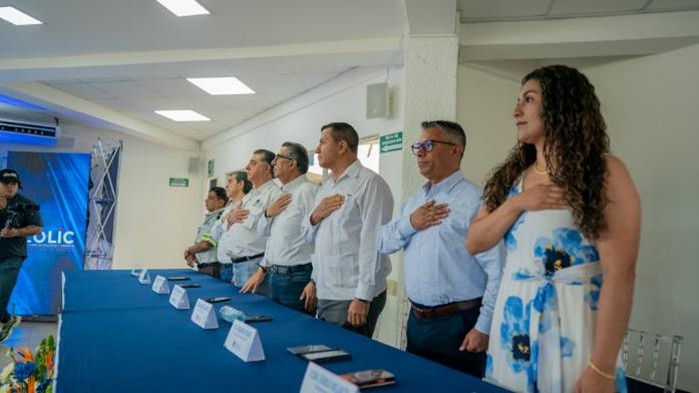
 ZOLIC Board of Directors, present
at the profit-sharing ceremony.
ZOLIC Board of Directors, present
at the profit-sharing ceremony.
As part of this performance, the
institution distributed its profits, in compliance with Article
26 of its Organic Law, transferring funds to the State, municipalities, and
employees, and strengthening its operational and reinvestment capacity.
This result is attributable to the
dynamic nature of business operations, the growth in the number of
new users at the Fiscal Complex and in the Public Special Economic Development
Zones (ZDEEP), as well as the implementation of strategies focused
on profitability and the efficient use of resources.
Profit Distribution
The distribution for
fiscal year 2025 was carried out as follows:
- 50% for the institution's operations
- 20% for the State
- 10% for municipalities where it operates
- 10% for the legal reserve
- 5% for staff
- 5% for Unemployment Benefits and Pensions
The contribution to the government totaled
Q2,488,372.14, which was handed over to the representative of the Departmental Government of
Puerto Barrios, Héctor Chávez.
 Héctor Chavez, Esq., in the center of
the photo, representing the Izabal Department Governor’s Office, received the
check for funds allocated to the State of Guatemala from the profits
of ZOLIC.
Héctor Chavez, Esq., in the center of
the photo, representing the Izabal Department Governor’s Office, received the
check for funds allocated to the State of Guatemala from the profits
of ZOLIC.
At the local level,
Q1,244,286.07 was allocated to the municipalities where ZOLIC and ZDEEP have
a presence, distributed as follows:
- Puerto Barrios: Q1,076,231.62
- Río Hondo, Zacapa: Q16,357.83
- Escuintla: Q56,517.83
- San José, Escuintla: Q57,270.22
- Pajapita, San Marcos: Q37,908.57
 Hugo Sarceño, mayor of Puerto
Barrios, pictured in the center, received the check for his municipality,
which came from ZOLIC's profits.
Hugo Sarceño, mayor of Puerto
Barrios, pictured in the center, received the check for his municipality,
which came from ZOLIC's profits.
These resources will contribute to the
implementation of projects that promote local development and the well-being of
communities.
Municipalities such as Puerto Barrios,
Río Hondo, Escuintla, and Pajapita benefit directly from this
distribution, as they are home to operations by ZOLIC and the ZDEEP Miel Verde, Zona
Libre Quetzal, Michatoya Pacífico, and Puerta del Istmo, establishing themselves as key
drivers of economic development.
Institutional Impact
For ZOLIC staff, the
allocation totaled Q622,143.04, an amount equivalent to that set aside for severance pay,
while Q6,221,430.36 was allocated to strengthen the institution’s
operations.
“At ZOLIC, we operate according to
principles of transparency and efficient management, ensuring that every resource
is administered responsibly. By law, our institution
operates with its own resources, and each year, a portion of these is transferred to
the State, the municipalities, and our employees. This model allows us to
position ourselves as a key facilitator in attracting investments that
generate economic development and social well-being for the country,” said Cristian
Mayorga, Chairman of the Board of Directors.
 Miguel Garcia, in the center of the
photo, received the check for the profits allocated to ZOLIC employees.
Miguel Garcia, in the center of the
photo, received the check for the profits allocated to ZOLIC employees.
For his part, Ricardo Segura,
General Manager of ZOLIC, noted:
“The results achieved demonstrate ZOLIC’s institutional efficiency and its ability
to adapt to changes in the environment. With 53 years of experience,
we continue to establish ourselves as a leader in providing
high-quality services aligned with international standards, which strengthens
investor confidence.”.
The generation and distribution of
profits not only demonstrate ZOLIC’s financial performance but also
strengthen its ability to reinvest in strategic projects, improve its
services, and establish itself as a key logistics platform for attracting
investment and fostering economic development in Guatemala.
With these results, ZOLIC
reaffirms its commitment to transparency, efficiency, and sustainable development,
solidifying its position as a strategic institution for the country’s
growth.