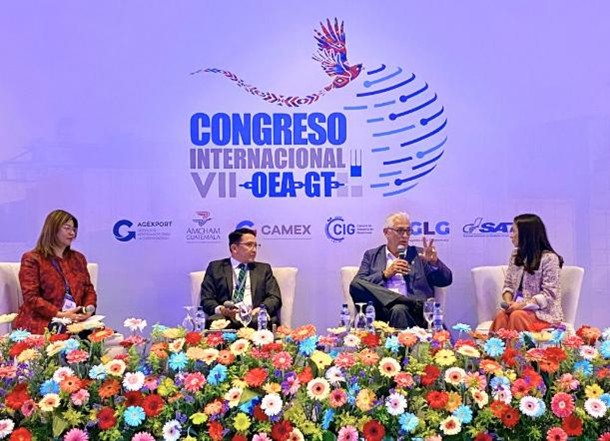
During the 7th OAS-WG Congress, held in June in Guatemala, the panel “Secure OAS Logistics Chain” made it clear that being an Authorized Economic Operator (AEO) is a real competitive advantage that transforms logistics chains and strengthens international trust.
Moderated by Patty Aguilar, director of the Logistics Association
of the Guatemalan Chamber of Industry, the panel brought together three
leading figures in their field—Ambev Guatemala, ZOLIC, and Distelsa—who shared
their experiences as entities authorized under the AEO program.
From the industrial sector, Susana Rosales, director of
Supply Chain at Cervecería Ambev Guatemala, described how the time it took to cross the border between Mexico and the ZDEEP Zona Libre
Puerta del Istmo has been a radical change. “Doing things differently, with
efficiency, and taking advantage of the SAT’s openness to improve processes as
a country—that is the real challenge. Being an AEO brings very significant
results in terms of profitability,” she noted.
From ZOLIC’s perspective, engineer Erick Tobar,
chairman of the Board of Directors, noted: “Being an OEA has made us a
more efficient Free Trade Zone, providing customs certainty and efficiency to our
users.” He emphasized that the ZDEEP Puerta del Istmo Free Trade Zone, located very
close to the border with Mexico, is the first to be authorized as an OEA-GT, and
they hope that the rest of the ZDEEPs under the ZOLIC regime will follow this path.”
 Ronald Fuentes, manager of
Operations at Distelsa, emphasized how the streamlining of customs procedures has
had a positive impact on the company’s internal goals: “It has been a
very satisfying experience, something we recommend to achieve greater
competitiveness,” he noted.
Ronald Fuentes, manager of
Operations at Distelsa, emphasized how the streamlining of customs procedures has
had a positive impact on the company’s internal goals: “It has been a
very satisfying experience, something we recommend to achieve greater
competitiveness,” he noted.
This panel highlighted success stories and reinforced one of the
congress’s central messages: OAS accreditation is a commitment to
traceability, safety, and efficiency—key pillars for Guatemala to
establish itself as a reliable regional logistics hub.
Regional Leadership in Guatemala
The 7th OAS-GT Congress brought together more than 300 key stakeholders
from the trade ecosystem: public institutions such as SAT, MINECO, and MAGA;
trade associations and business chambers such as AMCHAM, CAMEX, CIG, and AGEXPORT; as well as
representatives from the industrial, logistics, and commercial sectors in Guatemala and the
region.
It demonstrated Guatemala's regional leadership, with more
than 110 AEO-certified companies—a figure representing 59 % of the total in Central America. The results are clear: a 30% reduction %
during shipping times and a 20% reduction % in logistics costs.
 In addition to promoting efficiency,
the OAS program has paved the way for mutual international recognition,
consolidating Guatemala’s role as an active member of an
integrated Central American trade bloc.
In addition to promoting efficiency,
the OAS program has paved the way for mutual international recognition,
consolidating Guatemala’s role as an active member of an
integrated Central American trade bloc.
At this event, public-private cooperation was
reaffirmed as a key strategy for modernizing customs and strengthening
national competitiveness.
The Congress reaffirmed that the OAS framework is not an
end goal, but rather a model for collaboration that enables the country to move toward
safer, more efficient, and more reliable logistics, in line with the demands of
global trade.